Beyond one label
Percussion & Viola
Percussion and viola are not Charlotte's professional specialties. They are two instruments she has loved, left, returned to, and carried through different parts of her life.
Charlotte started percussion by accident. In her final year of high school, she had hoped to play piano in the string orchestra, but it conflicted with choir. The band needed someone who could read pitches and cover mallet parts, so she joined after a handful of hurried lessons. Before Covid shut everything down, the band went on tour and a university even offered her a percussion scholarship. She still was not sure whether she was any good.
Her Amherst percussion memories include sitting through a concert for three triangle notes, once crashing the cymbals four measures early in Mahler's First, rescuing nearby flutists from a collapsing suspended cymbal, and going underneath a xylophone to reach the vibraphone in time during Gershwin. Later, she sometimes played directly from the full score, including tam-tam and cymbals in Mahler's Fifth. She also performed John Cage's Living Room Music and Mark Applebaum's Catfish with the Amherst Percussion Ensemble.
Percussion is difficult to keep as an amateur without regular access to instruments and ensembles. Charlotte plays it less often now, and the word “percussionist” has slowly become less central to how she introduces herself. She still returns when a project needs her. Recent appearances have included timpani for Amherst College Vespers, snare drum for a choral Commencement concert, percussion at the Conductors Retreat at Medomak, and marimba in a Chattanooga Boys Choir staff talent show.
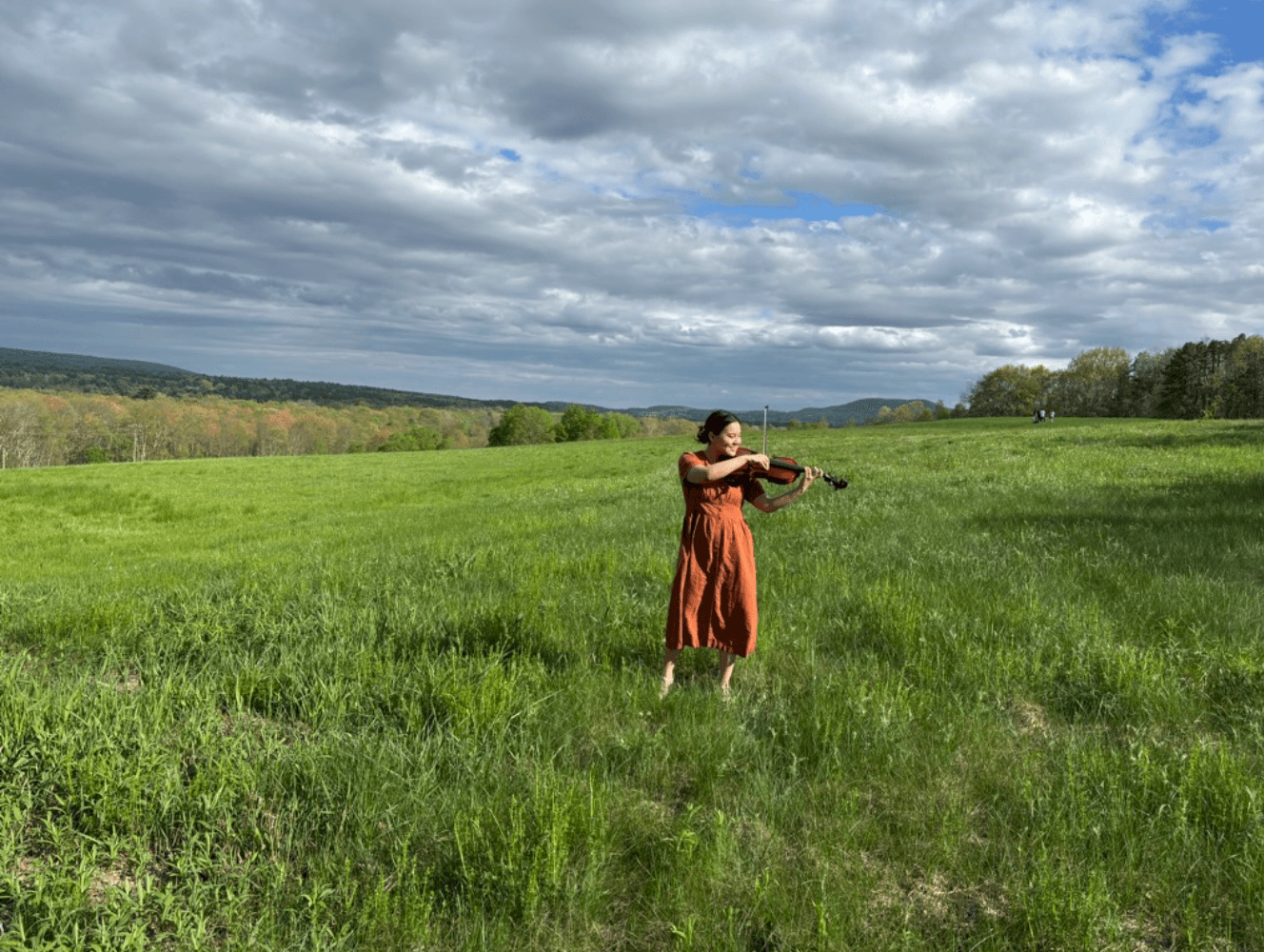
Charlotte began viola in early 2021. After only two or three weeks, she carried a rental instrument to Amherst's Book & Plow Farm and played simple melodies at sunrise. Four years later, at her final Amherst Symphony Orchestra gathering, she returned to the same fields with her own viola. By then, the instrument had taken her through orchestral concerts, chamber music, and the viola-and-voice duet she wrote upon leaving Amherst. The physical closeness of string playing—the sense that the instrument can breathe and tremble with the player—gave her a way of understanding sound that neither piano nor percussion had offered.
Neither instrument needs to become a profession to matter. Percussion is now something like an old friend Charlotte sees occasionally; viola is the instrument she can keep beside her, bring to a quartet with friends, or carry into a field. Both belong to her musical life without needing a professional title.